April 17, 2026
SEO for Websites in 2026: A Complete Guide to Ranking on Google, Bing, and AI Search
If you have a website, you’ve likely heard that SEO is important, but what that actually means in practice may not be obvious. For many businesses, especially those in creative or service-based industries, SEO can feel overly technical or disconnected from the more visible parts of their brand. And because of this uncertainty, SEO is often treated as something to get to later.
In reality, SEO is not a separate layer. Rather, it’s woven into how your website works, how it communicates, and how people find you in the first place.
At its core, Search Engine Optimization is about alignment. It’s about making sure your website reflects how people search, what they’re trying to understand, and how both search engines interpret your content. When everything is working together, SEO becomes less of a tactic and more of a secret engine behind your visibility, bringing in the right people at the right time.
What makes things more interesting, and a bit more complex, is how quickly search is evolving. We’re no longer just optimizing for traditional search results. AI-powered tools like Google’s AI Overviews and Microsoft Copilot are changing how information is delivered, often answering questions directly without requiring a click. That shift doesn’t make SEO less important. Instead it makes clarity, structure, and quality more important than ever.
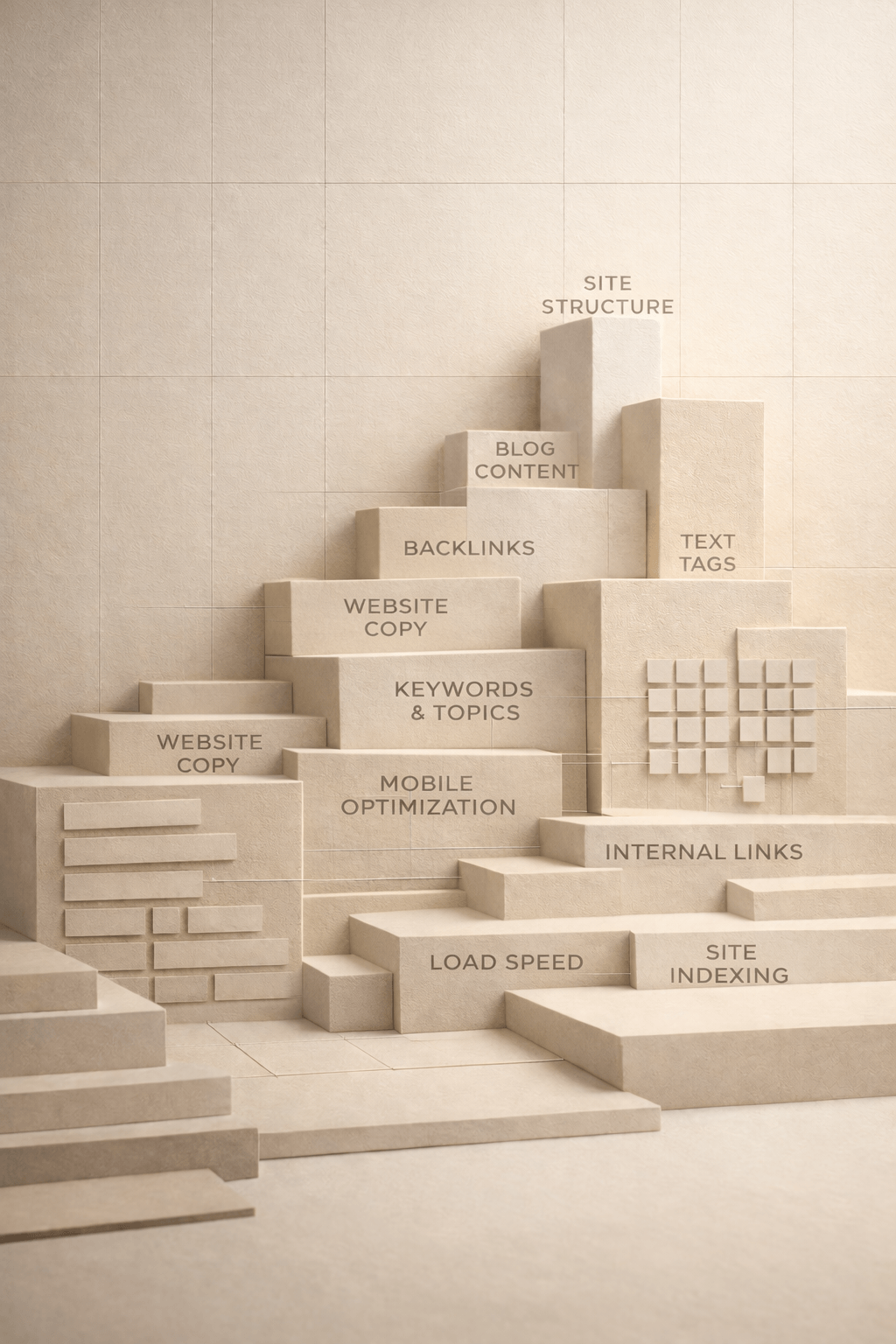
So instead of thinking about SEO as a checklist, it’s more helpful to think of it as a system. One that includes how your pages are structured, how your content is written, how your site performs, and how your brand shows up across the web.
In this guide, we’ll walk through all of it in a practical, approachable way so you can understand not just what to do, but why it matters.
What SEO Really Does for Your Website
Before diving into tactics, it helps to step back and understand what SEO is actually doing behind the scenes. At a high level, SEO is about helping search engines understand your website so they can confidently recommend it to the right people.
Search engines are constantly scanning the internet, discovering pages, organizing them, and deciding which ones best answer a given query. Your website is part of that ecosystem and good SEO ensures your content is both visible and competitive within it.
Connecting You With Intentional Traffic
One of the most valuable aspects of SEO is the type of traffic it brings in. Unlike social media or ads, where people may come across your work passively, search traffic is intentional. Someone is actively looking for something, and if your website aligns with that need, you’re positioned to meet them at exactly the right moment.
This is what makes SEO so powerful. It attracts people who are already interested, already searching, and often closer to making a decision.
Building Long-Term Visibility
Another important distinction is that SEO compounds over time. A well-optimized page can continue to perform for months or even years after it’s published. Unlike paid campaigns that stop when the budget runs out, SEO builds momentum.
Each improvement you make adds to that long-term visibility, whether it’s refining a page, publishing content, or improving site performance. Over time, your website becomes easier to find, more trusted, and more effective.
On-Page SEO: The Part that Communicates What You Do
On-page SEO refers to everything you can directly control on your website. It includes how your pages are structured, how your content is written, and how clearly your information is presented.
This is where most SEO efforts should begin. If your site doesn’t have relevant content or isn’t clear, organized, and useful, no amount of external optimization will fully compensate for that.
Writing for Clarity and Search Intent
Content clarity is one of the most underrated aspects of SEO. A page that contains the information you would expect to see on that page or clearly answers a question will almost always outperform one that tries to cover too much or overcomplicates its message. For example, an about page that includes pricing information would not perform well. Similarly, a blog article about SEO that talks about how to save time and money with content marketing strategies also would not perform well.
Search engines are focused on usefulness. They want to show results that solve a problem quickly and effectively, so that users will develop a sense of trust for the search engine and keep coming back. That means your content should be direct, easy to follow, and structured in a way that makes key points obvious.
This is also where user experience and content marketing come into play. If someone lands on your page and immediately understands what it offers, they’re more likely to stay, engage, and take action.
Using Keywords in a Natural, Intent-Driven Way
Keywords are still a core part of SEO, but the approach has shifted significantly. Instead of focusing on exact matches or repetition, modern SEO is about understanding intent.
What is someone really asking when they type a query? What are they trying to solve, learn, or decide?
By focusing on these questions, your content naturally aligns with the language people use. This is especially important as search becomes more conversational, with users typing full questions or using voice search.
Rather than forcing keywords into your content, it’s more effective to build your content around a topic and allow relevant terms to appear naturally. This leads to stronger, more readable pages that perform better over time.
Local SEO and Showing Up in Your Area
For businesses that operate within a specific region, local SEO adds another layer of relevance. It ensures that your website appears when people search for services in your area.
This isn’t just about adding a city name to your page. It’s about reinforcing your location across your website and external platforms. Mentions of your location within your content, consistent business listings, and accurate contact information all contribute to this.
Search engines use these signals to determine whether your business is relevant to a local query. When everything aligns, you’re far more likely to appear in results for people nearby.
Off-Page SEO: The Part That Keeps Everything Running Smoothly
Technical SEO tends to operate quietly in the background, which is why it’s often overlooked. It doesn’t change how your website looks on the surface, but it has a direct impact on how well that website functions, both for users and for search engines. At its core, technical SEO is about making sure your site is structured in a way that allows search engines to efficiently find, interpret, and present your content in search results.
When a search engine visits your website, it needs to be able to move through your pages without friction, understand what each page is about, and determine how it should be indexed. Technical SEO supports this process by ensuring your site is accessible, organized, and free from issues that might prevent proper crawling or indexing.
It also plays an important role in how your content is delivered to users. Factors like page speed, mobile responsiveness, and site security all fall under technical SEO. These elements influence not only how search engines rank your site, but also how people experience it once they arrive.
Without a strong technical foundation, even high-quality content can struggle to perform. Pages may not be indexed correctly, load too slowly, or fail to display properly on certain devices. In these cases, the issue is not the content itself, but the environment it exists in. By maintaining a solid technical base, you create the conditions that allow your content to be discovered, understood, and engaged with effectively.
Structuring Your Content with H1, H2, H3, and Paragraph Tags
Think of your page structure as the framework that holds everything together. Without it, even strong content can feel scattered or difficult to follow. Text tags, which are configured within web design software, contribute to a website’s structure by telling search engines how to “read” your content.
H1 headings set the main topic of the page. Each webpage should only have one H1 setting and it should clearly communicate what the page is about, both to the reader and to search engines. From there, H2 headings divide your content into meaningful sections, and H3 headings refine those sections further. Paragraph tags signal to search engines that the content in those sections support the headlines. It is critical that paragraph-tagged content support the main message of any heading that directly precedes it.
For users, this hierarchy creates a natural flow. It allows readers to scan quickly, find what they need, and stay engaged. At the same time, it helps search engines understand how your content is organized and which parts are most important.
In the context of AI search, this structure becomes even more valuable. Well-organized content is easier to interpret, summarize, and surface in generated responses.
Performance, Mobile Experience, and Crawlability
A technically sound website is fast, responsive, and easy to navigate. These factors influence both rankings and user experience.
Page speed affects how quickly users can access your content. Mobile responsiveness ensures your site works across devices. Crawlability ensures search engines can discover and index your pages without issues.
Together, these elements create a seamless experience that supports everything else you’re doing.
Search Console Tools and Webmaster Platforms
Search console tools act as your direct line of communication with search engines. They provide insight into how your site is being interpreted and where issues may exist.
Google Search Console allows you to see which pages are indexed, what queries bring users to your site, and whether there are errors affecting performance.
Microsoft Bing Webmaster Tools offers similar insights, along with integration into Bing’s ecosystem, including AI-powered features like Copilot. Using both platforms gives you a more complete view of your performance across search engines.
These tools are essential for ongoing optimization and we strongly recommend that you index your site with these tools as soon as you launch.
Building Trust Beyond Your Website
While on-page SEO focuses on the elements within your website’s pages and off-page SEO refers to the technical aspects of SEO, it is essential to also consider how your website is perceived by external sources. In many ways, it reflects the reputation your site has built across the broader internet and plays a key role in establishing credibility.
Search engines evaluate the content you publish, how it is coded, and also how your website is recognized and referenced by others. When other reputable sites link to your content, mention your brand, or engage with your pages, it signals that your website provides value. These external signals help search engines assess trustworthiness, authority, and relevance.
In many ways, off-page SEO acts as a form of validation. It shows that your website is part of a larger conversation and that others find it useful enough to reference. The stronger and more consistent these signals are, the more confidence search engines have in presenting your site within search results.
Why Backlinks Still Matter
Backlinks remain one of the strongest indicators of authority. When another website links to yours, it acts as a form of endorsement. It suggests that your content is worth referencing.
However, not all links carry the same weight. Links from reputable, relevant websites are far more valuable than those from low-quality or unrelated sources.
Earning backlinks often comes from creating content that is genuinely useful or interesting enough to be shared. It can also come from collaborations, features, or partnerships within your industry.
Your Broader Online Presence
Beyond backlinks, your overall presence online contributes to your credibility. Reviews, mentions, and social activity all help build a more complete picture of your brand.
Search engines use these signals to assess trustworthiness. A business that is consistently referenced, reviewed, and active across platforms tends to appear more reliable.
This doesn’t mean you need to be everywhere. It means showing up consistently in the places that matter most for your audience.
The Role of Content Creation in SEO
If SEO is the system that supports your website’s visibility, content is what actually fuels it. Without content, there’s very little for search engines to understand, rank, or recommend. Because of this, content is not merely a supporting element. Instead it is the core of how your website grows over time.
Content creation is what allows your site to evolve beyond a static set of pages into something dynamic and discoverable. It’s how you show up in more searches, answer more questions, and build a stronger connection with the people you want to reach.
Expanding Your Search Visibility in a Meaningful Way
At a foundational level, content increases the number of ways people can find you.
Most websites start with a small number of core pages: home, services, about, contact, maybe a portfolio. While these are important, they tend to target broader, more competitive search terms. That means they can only take you so far on their own.
Content changes that. Each new article, guide, or page gives you the opportunity to show up for more specific searches. These are often longer, more detailed queries that reflect real questions or needs. Someone searching for “how to choose a designer for a new brand or website” or “how to tell when you need a new website” is much closer to making a decision than someone searching for a general term like “branding” or “web design.”
By creating content around these types of searches, you’re meeting people at different stages of their journey. Over time, this builds a much wider and more intentional reach.
Building Authority and Trust Over Time
Content does so much more than increase visibility. It shapes how your website is perceived.
When your site consistently covers topics related to your field, it starts to build authority. And search engines will recognize these patterns over time. When they see that your website explores a topic from multiple angles with depth and consistency, your website will be prioritized over others than simply touch on the topic once.
This is often referred to as topical authority. It means your website becomes a more trusted source within a specific subject area, making it easier for your content to rank collectively, instead of just individually.
From a user perspective, this matters just as much. When someone reads a thoughtful, well-explained article on your site, it builds confidence. It shows that you understand your work and can communicate it clearly. That trust often carries forward into whether they choose to work with you.
Blogging as a Flexible and Strategic Tool
Blogging is one of the most accessible and effective ways to create content for SEO. It allows you to expand on ideas, answer common questions, and share insight in a way that your core pages often can’t.
Unlike service pages, which are usually more fixed and focused, blog content gives you room to explore. You can address specific concerns, break down processes, or provide guidance that helps your audience better understand what you offer.
What makes blogging particularly valuable is its longevity. A well-written post doesn’t lose its value after it’s published. In many cases, it continues to bring in traffic over time, especially if it answers a question that remains relevant.
Rather than thinking of blogging as something you need to constantly feed, it can be helpful to think of it as building a library. Each piece adds to a growing collection of knowledge that supports your website as a whole.
Creating Content That Works in an AI-Driven Search Landscape
As search continues to evolve, content is interpreted rather than simply ranked.
AI-powered search tools are designed to understand, summarize, and present information directly. This means your content needs to be not only informative, but also clear and structured in a way that makes it easy to extract meaning from.
Content that performs well in this environment tends to have a few things in common. It answers questions directly, avoids unnecessary complexity, and is organized in a logical way. Strong headings, concise explanations, and well-defined sections all contribute to this.
It’s less about writing differently and more about writing clearly. When your content is easy for a person to follow, it’s usually easier for AI systems to understand as well.
Strengthening Your Website Through Internal Connections
Content also plays an important structural role within your website, both because of the structure of individual pages and because of how those pages connect.
When you link between related pieces of content, you create pathways for both users and search engines to follow. A blog post can lead someone to a service page, which can then guide them to a portfolio or another article. This creates a more cohesive experience and helps distribute relevance across your site.
From an SEO perspective, internal linking helps search engines understand which pages are most important and how your content is related. From a user perspective, it makes your website feel more intuitive and easier to explore.
Consistency as a Long-Term Advantage
One of the most important, and often underestimated, factors in content creation is consistency.
Exceptional SEO performance never comes from a single piece of content. Instead it comes from the accumulation of many content pieces over time. Each article adds to your visibility, your authority, and your overall presence in search.
This doesn’t mean you need to publish constantly. What matters more is creating content on a steady, intentional basis. A consistent approach allows your website to grow naturally, without feeling rushed or forced.
Over time, this becomes one of your most valuable assets. Your content continues to work in the background, attracting visitors, building trust, and supporting your business in a way that feels sustainable.
When you step back, content creation is less about keeping up with SEO and more about creating something useful and lasting. It’s how your website becomes a resource instead of a one-time destination. And that’s what search engines, users, and AI systems are all ultimately looking for.
Why Content Strategy Matters for SEO
After building credibility beyond your website through backlinks, mentions, and your broader online presence and publishing relevant content, the next step is making sure everything you create is working together in a clear and intentional way. This is where content strategy becomes essential.
A strong content strategy ensures alignment across your entire presence. Your website, blog, and platforms like social media should reinforce one another. When someone moves from a social post to your website, or from a blog article to a service page, the experience should feel consistent in both message and value. This consistency strengthens your brand while also helping search engines better understand what your business focuses on.
From an SEO perspective, this kind of alignment builds clarity. Search engines are constantly trying to determine what your website is about and who it is relevant for. A well-defined content strategy removes ambiguity and shows that your site consistently addresses a set of related topics in a thoughtful and structured way.
It also helps ensure that your efforts are not wasted. Without a strategy, it is easy to create content that overlaps, misses key topics, or does not connect back to your core services. With a clear plan in place, each piece of content has a role. It either answers a question, supports a service, or guides someone further into your website.
When your content is both useful and aligned, it builds trust, supports your broader marketing efforts, and creates a more cohesive experience for your audience. Over time, that consistency becomes one of the strongest drivers of long-term SEO success.
Common SEO Mistakes to Avoid
Even with a strong, well-intentioned approach, it is easy for SEO to become less effective without it being immediately obvious. In many situations, the challenge is not a lack of effort, but where that effort is being applied. Time is often spent on tactics that seem important on the surface but have limited impact, while more foundational elements are overlooked. In other cases, the process becomes more complicated than it needs to be, or decisions are based on advice that no longer reflects how modern search engines operate.
SEO has evolved significantly, yet many outdated practices still persist. Techniques that once produced results may now limit performance, particularly as search engines have become more sophisticated in how they interpret content. With the growing influence of AI in search, there is an even greater emphasis on clarity, structure, and genuine usefulness. Content that is easy to understand and thoughtfully organized tends to perform far better than content that is heavily optimized in a rigid or mechanical way.
The positive side is that most SEO challenges are manageable once you know what to look for. Improvements often come from relatively small adjustments, such as refining page structure, clarifying messaging, or resolving technical issues. In many cases, there is no need for a complete rebuild. A more effective approach is to realign your existing content and structure so that everything works together in a clearer, more cohesive way.
Over-Optimizing Keywords Instead of Writing Naturally
One of the most persistent SEO habits is trying to “fit in” keywords as much as possible. While this used to work years ago, search engines have evolved significantly. Today, they’re much better at understanding context, meaning they no longer rely on repetition to determine relevance.
When keywords are forced into sentences, the writing often becomes awkward or repetitive. This doesn’t just affect SEO; it affects how people experience your brand. If something feels off or difficult to read, users are less likely to stay on the page or trust what they’re reading.
A better approach is to start with the topic and the question you’re trying to answer. If your content is clear and focused, relevant keywords will naturally appear without needing to be forced. In most cases, writing for clarity and usefulness will outperform writing for keywords.
Treating Structure as a Design Choice Instead of an SEO Tool
It’s common to think of headings and layout as purely visual decisions, but they play a much deeper role in how your content performs.
Without a clear structure, your page becomes harder to scan, harder to understand, and harder for search engines to interpret. A missing or unclear H1, inconsistent heading levels, or long blocks of uninterrupted text can all reduce the effectiveness of otherwise strong content.
Think of structure as a way of guiding both the reader and the search engine through your page. Clear sections, thoughtful hierarchy, and well-paced paragraphs make your content more accessible. They also make it far more likely to be picked up in AI-generated summaries, where structure plays a critical role.
Overlooking Technical Performance Until It Becomes a Problem
Technical SEO often gets pushed aside because it feels less visible or less urgent. But in reality, it quietly influences everything else.
A slow-loading page, broken links, or poor mobile experience can limit your visibility no matter how strong your content is. Search engines factor these elements into rankings, and users are quick to leave if something feels sluggish or difficult to navigate.
The challenge is that these issues don’t always announce themselves. A site can look polished on the surface while still underperforming behind the scenes.
Regularly checking performance, ensuring your site works seamlessly on mobile, and addressing small technical issues early can prevent larger problems later on. It’s less about perfection and more about consistency and maintenance.
Publishing Content Without a Clear Purpose
There’s often pressure to “keep posting,” especially when it comes to blogging. But publishing content without a clear goal or audience in mind can do more harm than good.
Content that exists just to fill space tends to be thin, repetitive, or unfocused. Over time, this can dilute the overall quality of your site and make it harder for search engines to understand what you actually specialize in.
Before creating a piece of content, it helps to ask a simple question: what is this meant to do? Is it answering a specific question? Explaining a service? Helping someone make a decision?
When content is created with intention, it tends to be more useful, more engaging, and more effective from an SEO perspective.
Ignoring the Insights Available in Search Console Tools
One of the most overlooked opportunities in SEO is the data already available to you. Tools like Google Search Console and Bing Webmaster Tools provide direct insight into how your site is performing, yet many websites rarely check them.
These platforms can show you which pages are being indexed, what keywords are driving traffic, where users are clicking, and where issues might be holding you back. Without this information, SEO becomes more of a guessing game.
Even a quick, occasional review can reveal patterns and opportunities. You might discover that a page is ranking just below the first page of results, or that a specific query is bringing in unexpected traffic. These insights can guide small adjustments that lead to meaningful improvements.
Assuming SEO is Static Instead of Evolving
One of the biggest misconceptions about SEO is that it’s something you “set up” and then leave alone. In reality, search is constantly changing.
User behaviour evolves, algorithms are updated, and new technologies, like AI-driven search, reshape how information is delivered. Strategies that worked a few years ago may no longer be effective today.
For example, content that is overly vague or loosely structured may struggle in AI-driven environments, where clarity and directness are prioritized. Similarly, relying on a handful of high-level keywords may not be enough as search becomes more conversational.
Staying effective with SEO doesn’t mean constantly chasing trends. It simply means staying aware, revisiting your content occasionally, and being open to refining your approach as things change.
Focusing on Tactics Instead of the Bigger Picture
Finally, one of the most subtle mistakes is focusing too heavily on individual tactics rather than the overall system.
SEO isn’t just about keywords, or backlinks, or technical fixes—it’s about how all of these elements work together. A well-structured page supports better content. Strong content earns links and engagement. Technical performance ensures everything can be accessed and understood.
When one part is out of balance, it can affect the whole.
Taking a step back and looking at your website as a connected system often leads to better decisions than trying to optimize each piece in isolation.
Avoiding these mistakes doesn’t require constant effort or complexity. It comes down to focusing on clarity, usefulness, and consistency: three things that not only improve SEO, but also create a better experience for the people visiting your site.
Rethinking SEO as a Long-Term Growth System
The most effective way to approach SEO is to stop thinking of it as a checklist and start seeing it as a system that supports your business over time.
Everything is connected. The way your pages are structured affects how your content performs. The quality of your content influences how your site is perceived. Your technical setup determines whether any of it can be properly seen.
And now, with AI shaping how search results are delivered, clarity and usefulness matter more than ever.
The good news is that you don’t need to chase every change. If your website is well-structured, your content is thoughtful, and you show up consistently, you’re already doing the work that matters most.
SEO isn’t about trying to outsmart search engines. It’s about making your work easier to find, easier to understand, and easier to trust.
And when you approach it that way, it starts to feel a lot less like a technical challenge and a lot more like a natural extension of your business.
Presenting Our Recent Work :
Return to the Archive Blog X




BORN & RAISED IN Calgary, Alberta AND IS
our ceo & lead designer WAS
proudly
Canadian
proudly Canadian.
Lauren Killam draws creative inspiration from both her academic background and global experiences. With a foundation in applied mathematics and anthropology, she brings a thoughtful blend of analytical precision and cultural curiosity to every project. Having lived in the Middle East and California before returning to Calgary, Lauren infuses her work with a rich mix of perspectives that are grounded in strategy, guided by empathy, and always ready to challenge the status quo.
Based in Calgary, Alberta and Proudly Canadian • Web Design • Graphic Design • Marketing Strategy • Visual Branding • Copy Writing • Product Development • Email Design • Social Media Design • SEO • Image Curation • Website Auditing • Based in Calgary, Alberta and Proudly Canadian • Web Design • Graphic Design • Marketing Strategy • Visual Branding • Copy Writing • Product Development • Email Design • Social Media Design • SEO • Image Curation • Website Auditing • Based in Calgary, Alberta and Proudly Canadian • Web Design • Graphic Design • Marketing Strategy • Visual Branding • Copy Writing • Product Development • Email Design • Social Media Design • SEO • Image Curation • Website Auditing • Based in Calgary, Alberta and Proudly Canadian • Web Design • Graphic Design • Marketing Strategy • Visual Branding • Copy Writing • Product Development • Email Design • Social Media Design • SEO • Image Curation • Website Auditing • Based in Calgary, Alberta and Proudly Canadian • Web Design • Graphic Design • Marketing Strategy • Visual Branding • Copy Writing • Product Development • Email Design • Social Media Design • SEO • Image Curation • Website Auditing •
Based in Calgary, Alberta and Proudly Canadian • Web Design • Graphic Design • Marketing Strategy • Visual Branding • Copy Writing • Product Development • Email Design • Social Media Design • SEO • Image Curation • Website Auditing • Based in Calgary, Alberta and Proudly Canadian • Web Design • Graphic Design • Marketing Strategy • Visual Branding • Copy Writing • Product Development • Email Design • Social Media Design • SEO • Image Curation • Website Auditing • Based in Calgary, Alberta and Proudly Canadian • Web Design • Graphic Design • Marketing Strategy • Visual Branding • Copy Writing • Product Development • Email Design • Social Media Design • SEO • Image Curation • Website Auditing •
Based in Calgary, Alberta and Proudly Canadian • Web Design • Graphic Design • Marketing Strategy • Visual Branding • Copy Writing • Product Development • Email Design • Social Media Design • SEO • Image Curation • Website Auditing • Based in Calgary, Alberta and Proudly Canadian • Web Design • Graphic Design • Marketing Strategy • Visual Branding • Copy Writing • Product Development • Email Design • Social Media Design • SEO • Image Curation • Website Auditing • Based in Calgary, Alberta and Proudly Canadian • Web Design • Graphic Design • Marketing Strategy • Visual Branding • Copy Writing • Product Development • Email Design • Social Media Design • SEO • Image Curation • Website Auditing • Based in Calgary, Alberta and Proudly Canadian • Web Design • Graphic Design • Marketing Strategy • Visual Branding • Copy Writing • Product Development • Email Design • Social Media Design • SEO • Image Curation • Website Auditing • Based in Calgary, Alberta and Proudly Canadian • Web Design • Graphic Design • Marketing Strategy • Visual Branding • Copy Writing • Product Development • Email Design • Social Media Design • SEO • Image Curation • Website Auditing •
Based in Calgary, Alberta and Proudly Canadian • Web Design • Graphic Design • Marketing Strategy • Visual Branding • Copy Writing • Product Development • Email Design • Social Media Design • SEO • Image Curation • Website Auditing • Based in Calgary, Alberta and Proudly Canadian • Web Design • Graphic Design • Marketing Strategy • Visual Branding • Copy Writing • Product Development • Email Design • Social Media Design • SEO • Image Curation • Website Auditing • Based in Calgary, Alberta and Proudly Canadian • Web Design • Graphic Design • Marketing Strategy • Visual Branding • Copy Writing • Product Development • Email Design • Social Media Design • SEO • Image Curation • Website Auditing •


Explore Our services
BrAND
IDENTITY
Refined branding that captures the heart of your business with clarity and elegance, leaving a lasting impression with every detail.
pause

Explore Our services
Graphic Design
Purposeful design that seamlessly blends style and function, crafting interactive experiences your audience will come to trust and depend on.
pause

Explore Our services
copy- writing
Carefully crafted copy that speaks with clarity and purpose, capturing your brand voice and compelling your audience to take action.
pause

Explore Our services
art direction
Curated art direction guides visual storytelling, upholding brand compliance and business objectives across multi-disciplinary teams.
pause

Explore Our services
Media curation
Thoughtfully curated media that aligns with your brand’s identity, bringing your message to life with authenticity and visual impact.
pause

Explore Our services
marketing strategy
Integrated, thoughtful strategy that bridges design and direction, shaping a clear path to attract and convert ideal clients with purpose and precision.
pause


Explore Our services
Search & AI
Optimization
Strategic search engine and AI optimization that amplifies your online presence, boosting visibility, driving traffic, and enhancing user experience.
pause

explore The Archive
explore
The Archive
Think of our blog as your insider pass to our private catalogue. You'll find expert insights and inspired guidance on everything from web design and copywriting to marketing strategy and creative inspiration. It’s all beautifully curated to help your business grow with style.

platform comparison

hot off the press

essential article
these are a few of
Our Things
Our
Things
favourite
QUICK DISCLOSURE
Many of the sections listed below contain affiliate links for products and services that our CEO has used and loved for years. This simply means that we may receive a commission if you purchase something from this page. It won't cost you more (in fact, a lot of these programs actually include special offers that save you money) and it really helps us out. Plus, ya know, we were going to share it with you anyway!

website builder
showit
the drag and drop
platform of dreams.
Showit is the RH of web design platforms. So, if you want a truly exquisite website without the six figure budget and months spent writing endless custom code, look no further.
SUBSCRIPTIONS START AT $22 USD/MONTH, BILLED YEARLY. You get A free month and so does Curator.

photography
sweet ginger
capture the Moments Your Heart will treasure.
It is our great pleasure to introduce you to Virginia. We are so deeply enamoured with her work, you can safely assume that any recent photograph of our CEO or family is a Sweet Ginger creation.
Investments vary by session type. you get a 15-minute mini session for $275 and WE get A $50 credit!

premium custom printing
Jukebox
the printer of dreams for Marketing Collateral
When you need materials to represent your brand in the analog world, trust Jukebox. Their proof system shows you exactly what your products will look like. #goodsurprisesonly
When you spend more than $50 on your order you get $25 off and we get a $25 credit.

Lead Magnets + More
BDOW!
the ultimate integrated conversion system
BDOW! gives you the best combination of features, flexibility, and pricing in the market. No coding required. Just everything you need to build high-converting experiences, connect your systems, and then launch, optimize, and grow.
send us an email to request discount info.

customer relationships
honeybook
Organize your business,
your way, all in one place.
HoneyBook is the software solution that has created the greatest freedom and ease in our business. We can focus on you because of its full suite of business management and client interaction tools.
SUBSCRIPTIONS START AT $16 USD/MONTH, BILLED YEARLY. You get 30% off your first year and we get up to $100.

Project management
Clickup
one (productivity) app
to replace them all.
What HoneyBook is to customer relationship management software, ClickUp is to project management software. We use ClickUp for lead magnet funnel strategies, and so much more.
Free plan available. I get $1.50 for free accounts and up to $20 per seat for paid accounts.

Digital workspace provider
Everything, everywhere, oraganized all at once.
Curator relies on Google Workspace to keep our business balanced with a productive and functional home life. Calendars, email, business and client files; this is how we manage our daily flow.
ask your project's lead designer for a unique promo code to get 10% off your first year.

information security
Keeper
Essential security for your everything.
We've been using Keeper to protect family passwords and streamline our home admin for YEARS. So, when I began my web design career, using Keeper for my business was the easiest choice ever.
Personal Plans begin at $2.92 USD/month. you get 30% Off and I get $30.

Financial management
quickbooks
the world's leader in business accounting
I can faithfully say that this is the most powerful accounting software I've used. While it's true that I appreciate QB's extensive features, its the numerous native integrations I treasure most.
subscriptions start at $24 CAD/month. You get 50% off your first 6 months and i get $100 CAD.

Business banking
Venn
stress-free and low-fee small business banking
We believe this is the most user-friendly and cost-effective business banking account available in Canada today. Sign up online, get instant cards, earn cashback, and don't get shocked by fees.
get an enrolment bonus of $100 when you spend more than $10,000 with your new venn card.

legal protection
WebsitePolicies
Website-Policies
simple cookie consent and privacy compliance
Cookie
& privacy compliance
The role of user activity data in a company's marketing activities is governed by complex legal frameworks. Compliance is essential, and websitepolicies makes it easy to stay on top of requirements.
The role of user activity data in a company's marketing activities is governed by complex legal frameworks. Compliance is essential, and Website-policies makes it easy to stay on track.
WebsitePolicies.com has the best pricing available. Choose the subscription that's right for you.

legal protection
contract shop
like your bff is a lawyer, but better.
like your bff is
a lawyer, but better.
It's no understatement to say that legal protection is an absolute necessity for every person or entity with an online presence. Website T&Cs, client contracts; you name it, you need it.
contract templates vary by type. You get peace of mind (priceless) and i get 20% on each sale.
The
BUSINESS


LOOKING for our INSTAGRAM?
Sorry, you're not going to find it.
Disappointed? Send us a quick note to strike up a conversation or request an in-person chat. We can't wait to meet you!

We respectfully acknowledge that our work takes place on the traditional and ancestral lands of the Treaty 7 region in Southern Alberta. This includes the Blackfoot Confederacy, comprising the Siksika, Piikani, and Kainai Nations, as well as the Tsuut’ina Nation and the Stoney Nakoda Nations of Chiniki, Bearspaw, and Goodstoney. We also recognize that Calgary is home to the Otipemisiwak Métis Government of the Métis Nation within Alberta, Region 3.
We honour the enduring relationships that Indigenous Peoples have with this land,
and we recognize that this territory has been a place of gathering, livelihood,
and cultural connection for over 10,000 years.
We acknowledge the deep and ongoing impacts of colonization, including displacement,
cultural erasure, systemic injustices, and intergenerational trauma that continue to affect
First Nations, Inuit, and Métis communities today. We recognize that
these harms are not only historical, but present and ongoing.
As a business, we are committed to listening, learning, and taking meaningful steps toward reconciliation. We strive to approach our work with respect, humility, and a responsibility to contribute, however we can, to a more equitable and inclusive future.
We honour the enduring relationships that Indigenous Peoples have with this land,
and we recognize that this territory has been a place of gathering, livelihood,
and cultural connection for over 10,000 years.
We acknowledge the deep and ongoing impacts of colonization, including displacement, cultural erasure, systemic injustices, and intergenerational trauma that continue to affect
First Nations, Inuit, and Métis communities today. We recognize that these harms are not only historical, but present and ongoing.
As a business, we are committed to listening, learning, and taking meaningful steps toward reconciliation. We strive to approach our work with respect, humility, and a responsibility to contribute, however we can, to a more equitable and inclusive future.
Home
Creative Services
Web Design
Brand Identity
Graphic Design
Copywriting
Art Direction
Media Curation
Strategy Services
Brand Strategy
Digital Strategy
About
The Archive Blog
Client Exhibitions
Join Curator
Questions & Answers
Contact Us

Showit vs. WordPress and 10 Reasons they Work Best Together

How to Create a Stand-Out Name for Your New Business
