October 17, 2025
7 Essential Questions Your Clients Need You to Answer
Visiting a website can be a deeply personal, or even intimate experience. Long before someone books a call or sends an inquiry, they steal a quiet moment, perhaps with a cup of tea, perhaps early in the morning before the kids wake up, or late in the evening after finishing a gruelling workday. Wherever and whenever these prospective clients squeeze you into their day, they are quietly assessing whether your business feels like the right fit. They are looking for reassurance. For clarity. For a sense of steadiness. Most importantly, they are looking for answers.
Often the questions your prospective clients are asking are those they may hesitate to speak aloud; the small, unspoken questions that surface as they scroll. When your website responds to those questions with care and transparency, something shifts. The experience feels more effortless, more approachable. More human.
Here are seven essential questions your clients need you to answer on your website before they feel comfortable establishing contact or engaging with your brand.
1. “Am I in the Right Place?”
This question arises almost instantaneously. Within seconds of arriving on your homepage, visitors are gently orienting themselves. They are scanning headlines, absorbing imagery, and trying to understand whether your business will be able to fulfill their need. Clarity here is invaluable.
Your homepage should articulate, in plain language, who you serve and what you help them achieve. Rather than relying on clever but ambiguous taglines, it can be far more effective to state your role clearly. For example, instead of saying “Creating a Future with New Possibilities,” which completely obscures what the company does or even which sector it’s in, you might say, “I hear you. I see you. I’ve got you. Transforming divorce into a journey of resolution and renewal.” (Psst, click here to explore the client exhibition).
As you can see, specificity builds confidence.
Imagery also plays a quiet but powerful role. When visitors see visuals that are aligned with your company’s industry, stage of growth, or aesthetic preferences, it creates recognition. They feel understood before they have even started reading.
In some circumstances, it can also be helpful to acknowledge who your offers are not a good fit for. Instead of feeling exclusionary, this kind of position can clarify alignment. When your message speaks directly to a defined audience, the right people feel welcome and the people who won’t want to seek your services, quickly leave without requiring time or resources from you to make the decision.
When visitors can answer “yes” to this first question without hesitation, they settle in. And once they settle in, they are far more open to everything that follows.
2. “Can I Trust You?”
Trust is built through a series of small, consistent signals that establish a framework for what makes each party feel safe with each other.
The visual presentation of your website is one of the most efficient ways to reference your values and boundaries to a prospective client. Clean design, thoughtful spacing, cohesive colours, and polished imagery suggest care and professionalism. A cluttered or outdated site, causes a subtle sense of doubt that will tarnish all future interactions and undermine copy, regardless of how persuasive it is.
Beyond aesthetics, however, visitors are looking for evidence. Testimonials are particularly powerful when they are specific. Rather than general praise, encourage past clients to share tangible outcomes or meaningful aspects of their experience. Alternatively, case studies, when presented clearly, allow prospective clients to see your process in action and understand the results you deliver.
Equally important is the human element. An “About” page that shares your values, philosophy, and approach helps visitors connect with your business on a human level. Professional photography can further reinforce this sense of authenticity.
Trust is rarely established through one bold statement. It grows through consistency, transparency, and thoughtful detail. Your website should feel like a steady handshake: confident, warm, and sincere.
3. “Do You Understand My Problem?”
Before clients invest in a solution, they want to feel understood in their challenge. Often, they arrive at your website carrying a quiet frustration. Perhaps the service or product they’re currently using feels misaligned. Maybe their systems feel chaotic. Possibly growth has stalled and they are unsure why.
When you articulate these struggles clearly and respectfully, something powerful happens: visitors feel seen. This does not require dramatic language or exaggerated pain points. In fact, a measured and perceptive tone can be far more effective. You might describe common scenarios you observe in your work or imagine three ideal clients and ask what makes you the best company to help them.
By naming these experiences thoughtfully, you demonstrate empathy and insight. You signal that you have worked with others in similar situations and that you understand the nuances involved.
It can also be helpful to acknowledge emotional dimensions: the uncertainty, the hesitation, the desire for clarity. Business or personal challenges are rarely purely logistical; they are often intertwined with identity and confidence.
When visitors feel understood, they become more receptive to your guidance. Understanding creates the foundation upon which your solution can genuinely resonate.
4. “What Exactly Do You Offer, and How Does It Work?”
Even the most compelling service loses its appeal if the details remain vague. Clients want to know what they are actually investing in. What is included? What is the structure? How long will it take? What is expected of them? Clarity here is an act of generosity.
Rather than listing abstract deliverables, consider outlining your process in stages. For example, you might describe a discovery phase, followed by strategy development, then implementation and refinement. This allows clients to visualise the journey and understand how each step builds upon the last. If your company offers products, it could be wise to provide information about troubleshooting, maintenance, or disposal. Or, if your product is something that is used repeatedly, it could be helpful to create a program or system to make future purchasing easier.
Providing approximate timelines can also be reassuring. Even if projects vary, offering a general range sets expectations and prevents misunderstanding.
You might also clarify practical elements: how communication takes place, how feedback is gathered, and what milestones mark progress. These details reduce ambiguity and demonstrate that your process is thoughtful and organized.
If you offer multiple packages or tiers, explain the differences plainly. Avoid overwhelming visitors with excessive options; simplicity often supports confident decision-making. When clients can clearly picture how the engagement will unfold, uncertainty fades. And when uncertainty fades, commitment feels far more comfortable.
5. “What Will This Cost?”
Pricing can feel delicate or even uncomfortable to discuss openly, yet silence around it often creates unnecessary friction. Because of this, pricing is one of the most nuanced elements of your website, and understandably so. It touches not only on numbers, but on positioning, confidence, and the way you frame your value.
There is no single correct pricing strategy, only the one that aligns with your business model, your audience, and the experience you wish to create. Some businesses adopt fixed, package-based pricing. This approach works beautifully when the scope is clearly defined and repeatable. It simplifies decision-making and allows clients to compare options with ease.
Others prefer custom proposals, particularly when projects vary significantly in complexity. In these cases, pricing is tailored to the specific needs and ambitions of the client. Other companies find that tiered offerings help clients engage their services more effectively, for example, foundational, comprehensive, and premium levels of service. This allows clients to select an investment level that feels appropriate while maintaining clarity around what each tier includes. Alternatively, value-based pricing focuses less on time or deliverables and more on the transformation or outcome your service creates.
Equally important is how you communicate your pricing. Some businesses choose full transparency, listing prices or starting rates directly on their website. This can be incredibly effective for filtering inquiries and ensuring budget alignment from the outset. It communicates openness and saves time for both parties.
Others prefer to share pricing only after an introductory call. This approach allows your business to first establish rapport, understand the client’s goals, and articulate the strategic value of your work before discussing numbers. For higher-investment or bespoke services that are unlikely to attract potential clients with insufficient budgets, this can provide essential context that a simple figure on a webpage cannot convey.
There are also hybrid approaches. You might list “starting at” rates, provide investment ranges, or include a minimum project threshold while reserving detailed proposals for later conversation.
Either way, the key is intention. Your pricing strategy and communication style should reflect your positioning and the level of service you provide. Whether you lead with transparency or with conversation, what matters most is that the approach feels aligned, confident, and respectful of your client’s decision-making process.
6. “What Will It Be Like to Work With You?”
Beyond deliverables and pricing, clients imagine the experience or working with you or engaging with your products or services while they explore your website.
They might wonder about whether the process will feel collaborative? Will they be guided step by step? Will communication be structured or flexible? These considerations matter deeply, particularly for longer-term or higher-investment engagements.
Your website can offer subtle but meaningful insight here. Describe your working style, such as whether you value thoughtful preparation and clear agendas, prioritize open dialogue and iterative feedback, or balance strategic rigour with creative exploration.
Sharing how often you communicate, how revisions are handled, and how decisions are made helps clients anticipate the rhythm of working together. It also filters for alignment; those who appreciate your approach will feel reassured.
You might include a brief statement about the kind of clients you most enjoy working with. This can create a sense of mutual selection rather than one-sided evaluation.
Ultimately, people want to know how they will feel throughout the process. Supported? Challenged? Organized? Inspired?
When your website conveys this experience honestly and thoughtfully, it allows clients to imagine themselves in partnership with you. And that imagination is often what leads to a productive inquiry and, ultimately, a conversion.
7. “What Should I Do Next?”
After absorbing all of this information, visitors appreciate clear guidance about how to engage with your company. Without this crucial step, even interested clients can hesitate. They may intend to return later, only to become distracted. A gentle, visible next step keeps momentum intact.
This does not require aggressive calls to action. In fact, for many refined brands, a calm invitation feels far more aligned. Phrases such as “Book a Consultation,” “Inquire About Working Together,” or “Schedule a Discovery Call” are both clear and courteous. Or, in our case, a simple button that says “Client Application” provides a direct path to initiating contact.
It can also be helpful to explain what happens after a client clicks. Will they receive a confirmation email? Will they complete a short questionnaire? What is the timeframe you will aim to respond within? These details remove uncertainty and make the step feel manageable.
Consider placing calls to action thoughtfully throughout your site, instead of only at the bottom of a product or service page. After describing your offer or sharing a case study, a gentle prompt can feel natural and supportive.
Ultimately, your role is to make the decision feel easy. When visitors know exactly what to do and what to expect, they are far more likely to move forward with confidence.
When your website answers these seven questions with clarity and warmth, it becomes a thoughtful guide that anticipates concerns, offers reassurance, and creates a seamless path from curiosity to commitment. And that cohesive, compassionate path is what turns visitors into clients.
Presenting Our Recent Work :
Return to the Archive Blog X



BORN & RAISED IN Calgary, Alberta AND IS
our ceo & lead designer WAS
proudly
Canadian
proudly Canadian.
Lauren Killam draws creative inspiration from both her academic background and global experiences. With a foundation in applied mathematics and anthropology, she brings a thoughtful blend of analytical precision and cultural curiosity to every project. Having lived in the Middle East and California before returning to Calgary, Lauren infuses her work with a rich mix of perspectives that are grounded in strategy, guided by empathy, and always ready to challenge the status quo.
Based in Calgary, Alberta and Proudly Canadian • Web Design • Graphic Design • Marketing Strategy • Visual Branding • Copy Writing • Product Development • Email Design • Social Media Design • SEO • Image Curation • Website Auditing • Based in Calgary, Alberta and Proudly Canadian • Web Design • Graphic Design • Marketing Strategy • Visual Branding • Copy Writing • Product Development • Email Design • Social Media Design • SEO • Image Curation • Website Auditing • Based in Calgary, Alberta and Proudly Canadian • Web Design • Graphic Design • Marketing Strategy • Visual Branding • Copy Writing • Product Development • Email Design • Social Media Design • SEO • Image Curation • Website Auditing • Based in Calgary, Alberta and Proudly Canadian • Web Design • Graphic Design • Marketing Strategy • Visual Branding • Copy Writing • Product Development • Email Design • Social Media Design • SEO • Image Curation • Website Auditing • Based in Calgary, Alberta and Proudly Canadian • Web Design • Graphic Design • Marketing Strategy • Visual Branding • Copy Writing • Product Development • Email Design • Social Media Design • SEO • Image Curation • Website Auditing •
Based in Calgary, Alberta and Proudly Canadian • Web Design • Graphic Design • Marketing Strategy • Visual Branding • Copy Writing • Product Development • Email Design • Social Media Design • SEO • Image Curation • Website Auditing • Based in Calgary, Alberta and Proudly Canadian • Web Design • Graphic Design • Marketing Strategy • Visual Branding • Copy Writing • Product Development • Email Design • Social Media Design • SEO • Image Curation • Website Auditing • Based in Calgary, Alberta and Proudly Canadian • Web Design • Graphic Design • Marketing Strategy • Visual Branding • Copy Writing • Product Development • Email Design • Social Media Design • SEO • Image Curation • Website Auditing •
Based in Calgary, Alberta and Proudly Canadian • Web Design • Graphic Design • Marketing Strategy • Visual Branding • Copy Writing • Product Development • Email Design • Social Media Design • SEO • Image Curation • Website Auditing • Based in Calgary, Alberta and Proudly Canadian • Web Design • Graphic Design • Marketing Strategy • Visual Branding • Copy Writing • Product Development • Email Design • Social Media Design • SEO • Image Curation • Website Auditing • Based in Calgary, Alberta and Proudly Canadian • Web Design • Graphic Design • Marketing Strategy • Visual Branding • Copy Writing • Product Development • Email Design • Social Media Design • SEO • Image Curation • Website Auditing • Based in Calgary, Alberta and Proudly Canadian • Web Design • Graphic Design • Marketing Strategy • Visual Branding • Copy Writing • Product Development • Email Design • Social Media Design • SEO • Image Curation • Website Auditing • Based in Calgary, Alberta and Proudly Canadian • Web Design • Graphic Design • Marketing Strategy • Visual Branding • Copy Writing • Product Development • Email Design • Social Media Design • SEO • Image Curation • Website Auditing •
Based in Calgary, Alberta and Proudly Canadian • Web Design • Graphic Design • Marketing Strategy • Visual Branding • Copy Writing • Product Development • Email Design • Social Media Design • SEO • Image Curation • Website Auditing • Based in Calgary, Alberta and Proudly Canadian • Web Design • Graphic Design • Marketing Strategy • Visual Branding • Copy Writing • Product Development • Email Design • Social Media Design • SEO • Image Curation • Website Auditing • Based in Calgary, Alberta and Proudly Canadian • Web Design • Graphic Design • Marketing Strategy • Visual Branding • Copy Writing • Product Development • Email Design • Social Media Design • SEO • Image Curation • Website Auditing •


Explore Our services
BrAND
IDENTITY
Refined branding that captures the heart of your business with clarity and elegance, leaving a lasting impression with every detail.
pause

Explore Our services
Graphic Design
Purposeful design that seamlessly blends style and function, crafting interactive experiences your audience will come to trust and depend on.
pause

Explore Our services
copy- writing
Carefully crafted copy that speaks with clarity and purpose, capturing your brand voice and compelling your audience to take action.
pause

Explore Our services
art direction
Curated art direction guides visual storytelling, upholding brand compliance and business objectives across multi-disciplinary teams.
pause

Explore Our services
Media curation
Thoughtfully curated media that aligns with your brand’s identity, bringing your message to life with authenticity and visual impact.
pause

Explore Our services
marketing strategy
Integrated, thoughtful strategy that bridges design and direction, shaping a clear path to attract and convert ideal clients with purpose and precision.
pause


Explore Our services
Search & AI
Optimization
Strategic search engine and AI optimization that amplifies your online presence, boosting visibility, driving traffic, and enhancing user experience.
pause

explore The Archive
explore
The Archive
Think of our blog as your insider pass to our private catalogue. You'll find expert insights and inspired guidance on everything from web design and copywriting to marketing strategy and creative inspiration. It’s all beautifully curated to help your business grow with style.

platform comparison

hot off the press

essential article
these are a few of
Our Things
Our
Things
favourite
QUICK DISCLOSURE
Many of the sections listed below contain affiliate links for products and services that our CEO has used and loved for years. This simply means that we may receive a commission if you purchase something from this page. It won't cost you more (in fact, a lot of these programs actually include special offers that save you money) and it really helps us out. Plus, ya know, we were going to share it with you anyway!

website builder
showit
the drag and drop
platform of dreams.
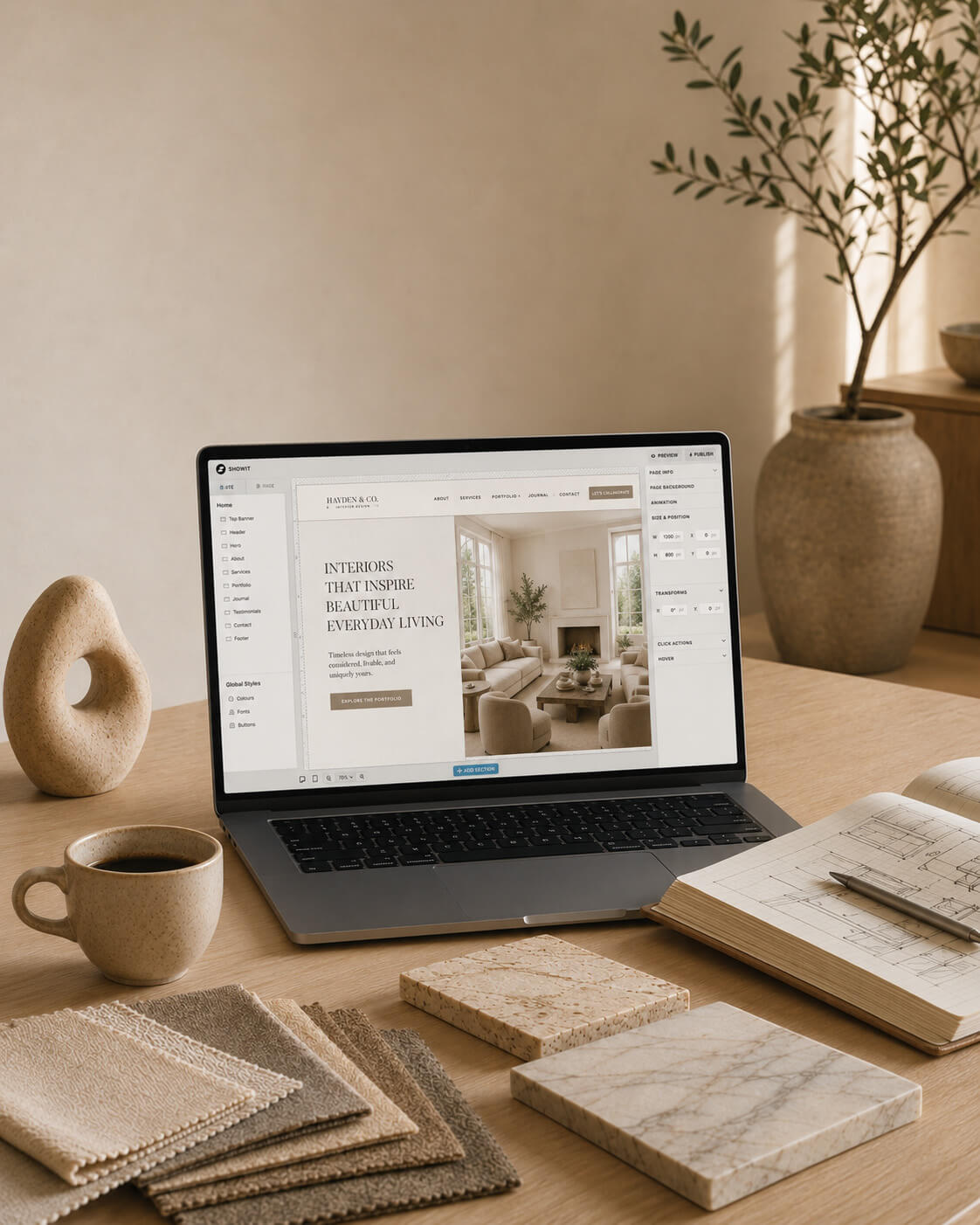
Showit is the RH of web design platforms. So, if you want a truly exquisite website without the six figure budget and months spent writing endless custom code, look no further.
SUBSCRIPTIONS START AT $22 USD/MONTH, BILLED YEARLY. You get A free month and so does Curator.

photography
sweet ginger
capture the Moments Your Heart will treasure.
It is our great pleasure to introduce you to Virginia. We are so deeply enamoured with her work, you can safely assume that any recent photograph of our CEO or family is a Sweet Ginger creation.
Investments vary by session type. you get a 15-minute mini session for $275 and WE get A $50 credit!

premium custom printing
Jukebox
the printer of dreams for Marketing Collateral
When you need materials to represent your brand in the analog world, trust Jukebox. Their proof system shows you exactly what your products will look like. #goodsurprisesonly
When you spend more than $50 on your order you get $25 off and we get a $25 credit.

Lead Magnets + More
BDOW!
the ultimate integrated conversion system
BDOW! gives you the best combination of features, flexibility, and pricing in the market. No coding required. Just everything you need to build high-converting experiences, connect your systems, and then launch, optimize, and grow.
send us an email to request discount info.

customer relationships
honeybook
Organize your business,
your way, all in one place.
HoneyBook is the software solution that has created the greatest freedom and ease in our business. We can focus on you because of its full suite of business management and client interaction tools.
SUBSCRIPTIONS START AT $16 USD/MONTH, BILLED YEARLY. You get 30% off your first year and we get up to $100.

Project management
Clickup
one (productivity) app
to replace them all.
What HoneyBook is to customer relationship management software, ClickUp is to project management software. We use ClickUp for lead magnet funnel strategies, and so much more.
Free plan available. I get $1.50 for free accounts and up to $20 per seat for paid accounts.

Digital workspace provider
Everything, everywhere, oraganized all at once.
Curator relies on Google Workspace to keep our business balanced with a productive and functional home life. Calendars, email, business and client files; this is how we manage our daily flow.
ask your project's lead designer for a unique promo code to get 10% off your first year.

information security
Keeper
Essential security for your everything.
We've been using Keeper to protect family passwords and streamline our home admin for YEARS. So, when I began my web design career, using Keeper for my business was the easiest choice ever.
Personal Plans begin at $2.92 USD/month. you get 30% Off and I get $30.

Financial management
quickbooks
the world's leader in business accounting
I can faithfully say that this is the most powerful accounting software I've used. While it's true that I appreciate QB's extensive features, its the numerous native integrations I treasure most.
subscriptions start at $24 CAD/month. You get 50% off your first 6 months and i get $100 CAD.

Business banking
Venn
stress-free and low-fee small business banking
We believe this is the most user-friendly and cost-effective business banking account available in Canada today. Sign up online, get instant cards, earn cashback, and don't get shocked by fees.
get an enrolment bonus of $100 when you spend more than $10,000 with your new venn card.

legal protection
WebsitePolicies
Website-Policies
simple cookie consent and privacy compliance
Cookie
& privacy compliance
The role of user activity data in a company's marketing activities is governed by complex legal frameworks. Compliance is essential, and websitepolicies makes it easy to stay on top of requirements.
The role of user activity data in a company's marketing activities is governed by complex legal frameworks. Compliance is essential, and Website-policies makes it easy to stay on track.
WebsitePolicies.com has the best pricing available. Choose the subscription that's right for you.

legal protection
contract shop
like your bff is a lawyer, but better.
like your bff is
a lawyer, but better.
It's no understatement to say that legal protection is an absolute necessity for every person or entity with an online presence. Website T&Cs, client contracts; you name it, you need it.
contract templates vary by type. You get peace of mind (priceless) and i get 20% on each sale.
The
BUSINESS


LOOKING for our INSTAGRAM?
Sorry, you're not going to find it.
Disappointed? Send us a quick note to strike up a conversation or request an in-person chat. We can't wait to meet you!

We respectfully acknowledge that our work takes place on the traditional and ancestral lands of the Treaty 7 region in Southern Alberta. This includes the Blackfoot Confederacy, comprising the Siksika, Piikani, and Kainai Nations, as well as the Tsuut’ina Nation and the Stoney Nakoda Nations of Chiniki, Bearspaw, and Goodstoney. We also recognize that Calgary is home to the Otipemisiwak Métis Government of the Métis Nation within Alberta, Region 3.
We honour the enduring relationships that Indigenous Peoples have with this land,
and we recognize that this territory has been a place of gathering, livelihood,
and cultural connection for over 10,000 years.
We acknowledge the deep and ongoing impacts of colonization, including displacement,
cultural erasure, systemic injustices, and intergenerational trauma that continue to affect
First Nations, Inuit, and Métis communities today. We recognize that
these harms are not only historical, but present and ongoing.
As a business, we are committed to listening, learning, and taking meaningful steps toward reconciliation. We strive to approach our work with respect, humility, and a responsibility to contribute, however we can, to a more equitable and inclusive future.
We honour the enduring relationships that Indigenous Peoples have with this land,
and we recognize that this territory has been a place of gathering, livelihood,
and cultural connection for over 10,000 years.
We acknowledge the deep and ongoing impacts of colonization, including displacement, cultural erasure, systemic injustices, and intergenerational trauma that continue to affect
First Nations, Inuit, and Métis communities today. We recognize that these harms are not only historical, but present and ongoing.
As a business, we are committed to listening, learning, and taking meaningful steps toward reconciliation. We strive to approach our work with respect, humility, and a responsibility to contribute, however we can, to a more equitable and inclusive future.
Home
Creative Services
Web Design
Brand Identity
Graphic Design
Copywriting
Art Direction
Media Curation
Strategy Services
Brand Strategy
Digital Strategy
About
The Archive Blog
Client Exhibitions
Join Curator
Questions & Answers
Contact Us

Showit vs. WordPress and 10 Reasons they Work Best Together

How to Create a Stand-Out Name for Your New Business
